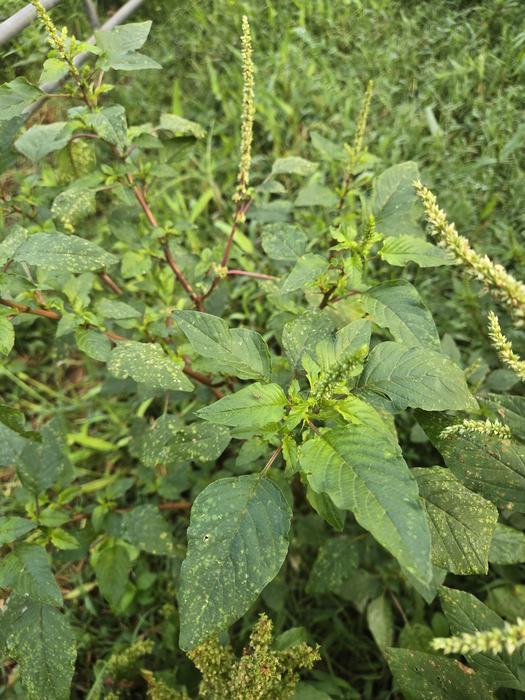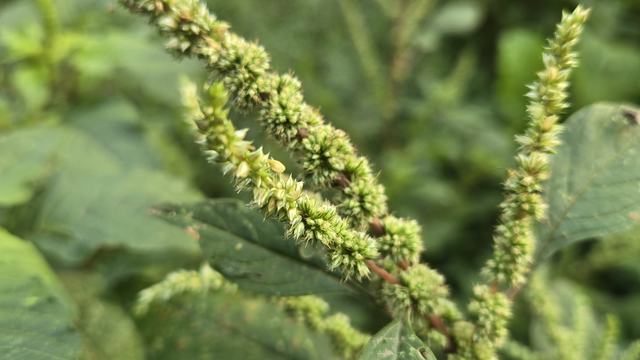
Spiny amaranth is commonly known as “pigweed”. It is a warm-season annual, native to North America and found worldwide. While spiny amaranth is edible – leaves can be used in assorted stir-fry dishes and soups. Fruits and roots are used medicinally in some cultures, and seed provides food for songbirds. But in pastures and cropland, pigweed is typically considered a weed.
Spiny amaranth grows upward and can reach 5 feet in height. It can have a bushy appearance but has smooth stems and leaves. Leaf nodes have a pair of sharp spines, which give the plant its name. Stems often have a red to purple pigmentation. Seeds are very small (~0.03 inch) and may be spread by wind, water, animals, or equipment. Seeds germinate mostly on the soil surface.
The plants prefer warm, loamy soil high in organic matter so they thrive in feeding zones in pastures and a single plant can produce 235,000 seeds. Spiny amaranth can compete fairly well once it is established and can be found interspersed even in dense, tall stands of grass.
Livestock will consume the spiny amaranth plant, especially when it is small and stems are tender and less spiny. As the plant matures, the stems become less desirable; however, livestock will still select the leaves off the plant, especially small ruminants. Nitrates can be a problem with pigweed, especially in drought conditions. Pigweed, especially dried, can be high in oxalates; when consumed in large amounts can lead to kidney failure.
Herbicides can offer reasonable control in pastureland and hay fields; however, they may also eliminate desirable broadleaf plants. Product labels usually recommend application before the plants reach 6 inches in height. 2,4-D alone is not the most effective herbicide; mixing with dicamba or triclopyr can improve control. Aminopyralid products offer effective control in pastures, but are not labeled for use in hay fields where the hay will be sold off the farm.